
TOUGH TIMES:
TOUGHER TEAMS
What is the surest, fastest way through the fog of the pandemic and its impact on your company, your culture, and your customers?

SLAP’S renowned expertise is in understanding exactly how manager, employee, and customer cultures really work.
And how to get yours to really work for you. The True Definition of Culture1. WHY WE GET THE CALL
Three things. Or everything.
Urgency.
“We need to execute on a critical internal transformation or go-to-market strategy." "The plan is ready to launch right now or it’s coming soon, and it has to work.”
Frustration.
“It’s another year and with so much wasted energy: Another strategic kick off." "Another one-team initiative." "Another ad campaign. More discounting." "The only way this year’s strategy is going to move forward is when it’s slammed from behind by next year’s strategy.”
Desire.
“Since we have managers and employees, we’re going to provide the most fulfilling, productive career they could ever have." "Since we have customers, we’re going to set the bar so high for the quality of our customer experience, no competitor will ever reach it.”
For 24 years, in 44 countries, SLAP has achieved billions of dollars of performance improvement for many successful, demanding companies.
The kind that don’t include “Patience” on their list of corporate values.2. WHO CALLS:
SOME OF OUR CLIENTS
They've seen it all. They choose SLAP.




















A great culture is a committed culture. Its commitment can be measured by any performance metric you use to manage your business.
LET'S TALK MEASURABLE RESULTS3. HOW WE ANSWER THE CALL:
THE SLAP SOLUTIONS
Unique and Contrarian. Proven and Measurable.
TOUGH TIMES
TOUGHER TEAMS

BURY MY HEART AT CONFERENCE ROOM B

BRAND STRATEGY

UNDER THE HOOD
ANALYSIS AND ACTION

HEAVEN
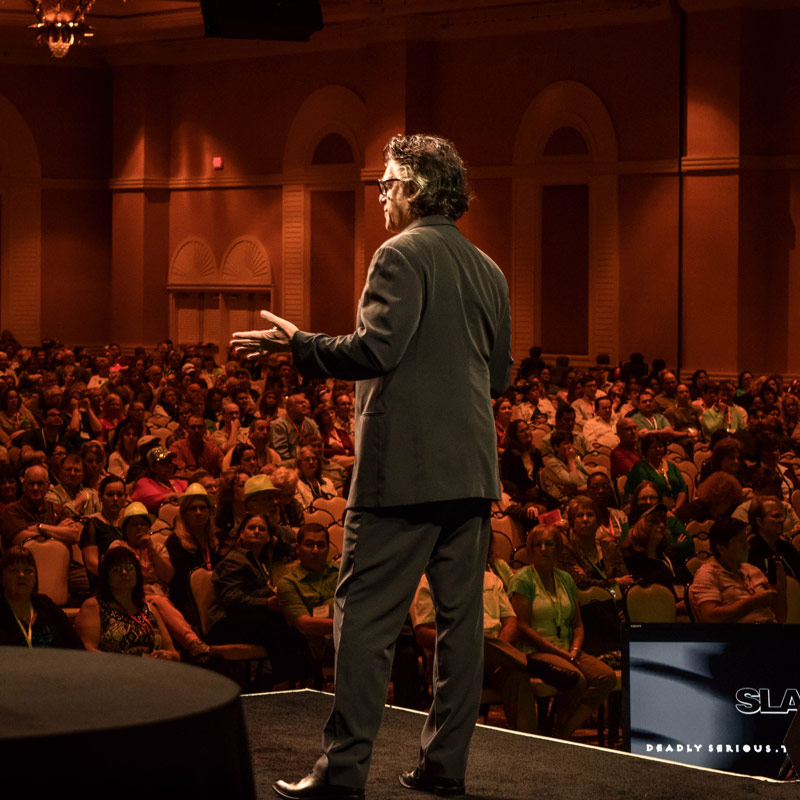
KEYNOTES

UNDER THE HOOD
TRANSFER OF COMPETENCY

BACK TO THE GARAGE
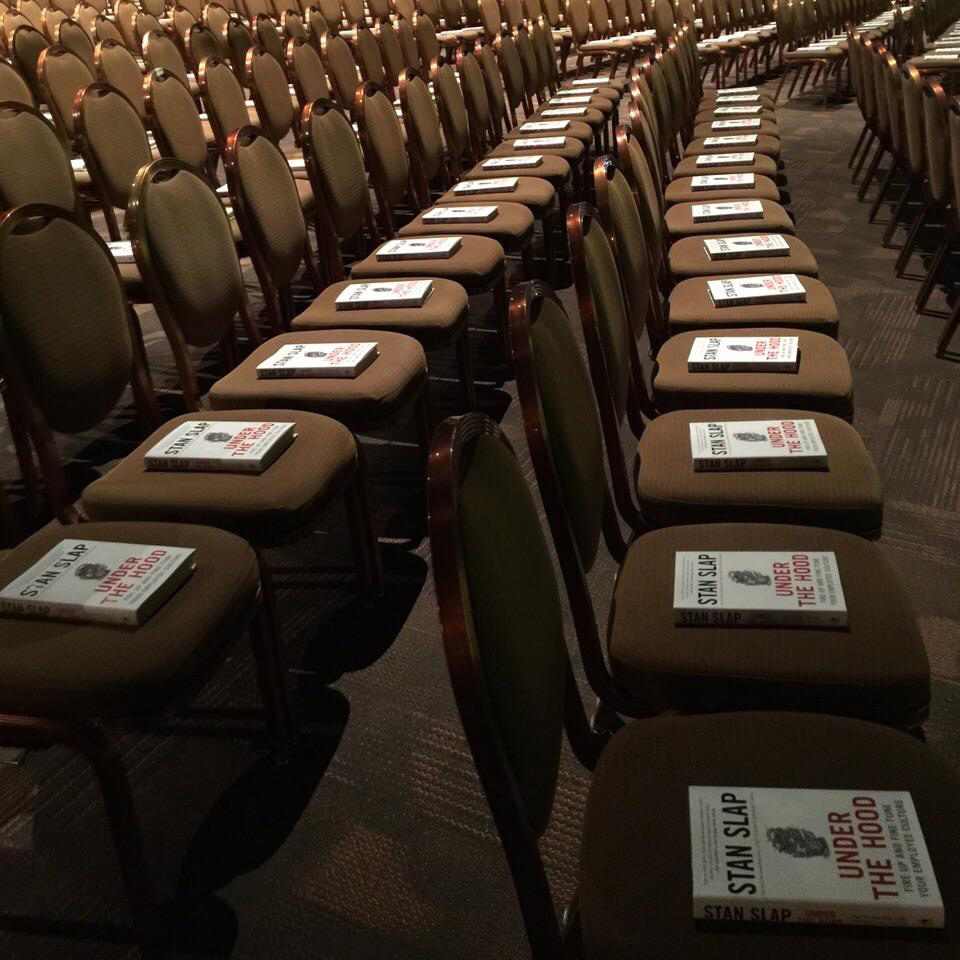
BOOKS
THE NEW VIRTUAL VERSIONS OF OUR SOLUTIONS
We’re thrilled that the in-person versions of SLAP solutions have earned a worldwide reputation for their unique, extraordinary impact. Like you, we hadn’t planned on the Age of Human Contact screeching to a halt in our lifetime and look forward to its resurgence. In the meantime, we have spent many months redeveloping our solutions for virtual delivery.
The SLAP team that developed the original versions has built these virtual versions, with lots of input/interference from Stan Slap. They are based on the same unique IP. They retain the same focus on measurable business outcomes and transfer of competency, the same big epiphanies, the same actionable steps. And they remain immaculately empathetic to the real and surreal world of a manager. Our facilitation team has been certified in the new versions, so they’ll be presented to your managers with the same skill.
We are confident that the virtual versions are of the ridiculously high standard set for the in-person versions.
4. WHAT HAPPENS WHEN WE ANSWER:
SOME TESTIMONIALS
The only one that's missing is yours. Let's fix that.
“There is no one on this planet that better understands how to get desired cultural response than SLAP. Over the last fifteen years I have deployed them in three companies doing battle in intensely competitive markets.
“They have never failed to deliver outstanding results.”
“When I first took over our $12-billon channel business, our CEO Mark Hurd sent me a one-sentence email that said, ‘You are now in charge of the worst-running organization in the entire company.’ Two years later, he sent me another email that said, ‘You are now in charge of the best-running organization in the entire company.’
“The difference was SLAP. Their value and ROI are unquestionable.”
“I can say without hesitation that SLAP changed the potential of our entire company.”
“SLAP has made a significant, long-term difference in the commitment of our managers and their ability to achieve results through others. Their methods were transformational for me and for our entire organization.”
“SLAP was the primary reason that we were able to make massive operating changes without disrupting our all-important culture and soul. They helped us grow our most profitable division by 300%.
“Our executive team voted the SLAP company as one of the ten most important things to ever happen to our company.”
“Experiencing SLAP’s cultural process was like taking the red pill in The Matrix. Everything was suddenly revealed for our executive team.”
“I have never met anyone who knows more about culture than Stan Slap.”
“Before SLAP, my division was losing $116M a year. After SLAP, we’re $100M to the good and we’ve gained 10% market share even after raising our prices 3%. I absolutely credit them as the driving force behind our turnaround.
When I brought SLAP into our company I billed them as ‘potentially life changing.’ Their work delivered on that promise and continues to do so.”
“Whenever I meet with Stan Slap, I don’t know whether to write down everything he says or leap across the desk and strangle him.”
“The brilliance of the SLAP company’s solutions lies in their radical ideas. They are the crown jewel in Oracle’s management development curriculum and justifiably the highest rated development process in our company’s history.
We rate SLAP as an exceptional contributor to our business performance.”
When you think of computers, think of Steve Jobs. When you of e-commerce, think Jeff Bezos. When you think of culture, think Stan Slap. His work is the best I've ever seen.
“We have seen it all and worked with the very best. I believe SLAP offers a path to improving our client experience like no one else does.”
|
“Amongst their valuable solutions, SLAP is uniquely effective in clarifying what is personally important to executives in order to recommit them to their work. I was a senior executive at both Oracle and Microsoft and witnessed the impact on our executives in both of those companies. We are getting the same results at Electronic Arts.” |
|
“After a single exposure to Stan Slap’s unique thinking, we asked him to join our board of directors. His company’s solutions stick. They immediately entered the pulse and bloodstream of this company.” |
|
“I have been on the inside of a company that became a brand and I can tell you that SLAP has the most accurate process I’ve ever seen for causing that to happen in your company.” |
|
“From Proctor and Gamble to PepsiCo, I’ve had a lot of management theory in my career. The SLAP company blows everything else away in terms of substance and impact.” |
|
“I have employed many big strategic thinkers over the years. Noel Tichy, Michael Porter, and C.K. Prahalad are a few that come immediately to mind. I have learned more from Stan Slap than from any of these people. The lessons of his company’s solutions continue to echo in my head as the ultimate truth about how a business should be run.” |
|
“The full SLAP approach to creating what they call a ‘brandable customer experience’ does exactly that. Their process is the best I’ve seen in all my years in business.” |
|
“The internal commitment generated for us by SLAP is priceless.” |
I wish we'd had SLAP at GE during our branding efforts.
The True Definition of Culture
Three groups are deciding the success ofyour business while you read this sentence.
Here’s what to do about it.
When your manager culture, your employee culture, and your customer culture want something to happen in your company, it will happen. When they don’t, it won’t. We’re not talking about a bunch of managers, employees, and customers here. When these groups formed relationships with your company they became cultures and became far more resistant to standard methods of corporate influence.
Given that the success of your company and your career involves achieving results through others, understanding the true motivations of a culture is the most critical information you can have. As critical is that “culture” remains the most overused, yet typically least understood, concept in business. Let’s fix that for you right now.
Why a culture exists
A culture is created whenever a group of people share the same basic living circumstances and so band together to share beliefs about the rules of survival and emotional prosperity. “How do we survive, living in this jungle [this company], in this tribe [this team], with this chief [this manager]? Once we know we’re going to be okay, how do we then get rewarded emotionally and avoid punishment?” Your culture is not the beliefs about “the way things are done around here.” That’s just the currency of the culture. Your culture is the self-protective organism that obsessively collects information, attempts to validate its credibility, and shares its beliefs privately amongst itself as a guide to its own survival.
A culture is an independent organism, living right inside your company, with its own purpose and all the power to make or break any management plan. Its purpose is to protect itself, and it will only offer protection to your company when it perceives a reliable through line between happens for the company with what happens for the culture. Cultural commitment only happens when your culture believes that protecting the company is the same as protecting itself.
The bad news
A culture is an information-gathering organism designed to assure its own survival. As such, its antennae is working constantly, its credibility detector is nearly infallible, its perceptions are alarmingly accurate, and its memory is elephantine. You can’t bluff, bribe, or bully a culture into sustainably believing or doing anything. You can’t tell it what to believe and you can’t stop it from existing. Your cultures are not anti-company, anti-management, or anti-performance, but they are definitely anti-unsafe and will resist anything that poses perceived risk to their survival and emotional prosperity.
The much better news
Your cultures will give you whatever you want. You just have to give them what they want first. Respecting what they want is the difference between their defiance and their compliance. Remember: It is not the responsibility of your cultures to understand your business logic; it is the responsibility of your business to understand the cultures’ logic. Get this and you will be unbeatable in any market you choose to own.
The ultimate impact
The biggest commitment your cultures can give you won’t be seen until they need to show it: If your company ever gets into trouble, only a committed culture will step up to save you. You may not need this protective evangelism from your cultures today, but you’ll need it someday — every company needs it one day. You can’t bank it when you need it; you have to put it away ahead of time.
Maximizing the commitment of your manager, employee, and customer cultures is not only about achieving performance. It is about achieving performance insurance.
MAKE THE CALL
Let’s talk about measurable results that can only come from the maximum commitment of your manager, employee, and customer cultures.
SLAP
450 Geary St.
Suite 100
San Francisco, CA 94102
(415) 362-1240